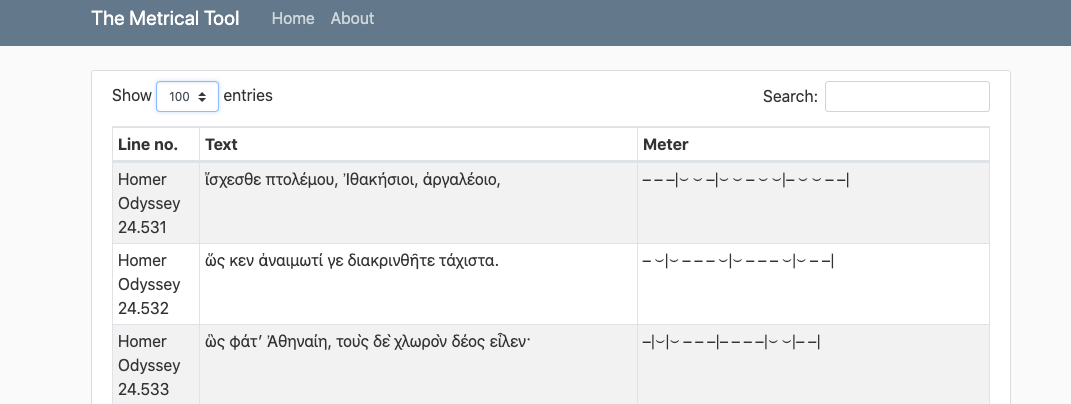
These are some notes to accompany my online presentation at the Society for Classical Studies convention, January 2021.
The actual presentation may be found here (on YouTube).
Articles and books to which I refer in the presentation are:
- A. W. Bulloch, “A Callimachean Refinement to the Greek Hexameter,” Classical Quarterly 20 (1970): 258–268.
- D. S. Raven, Latin Metre (London, 1965).
- Richard F. Thomas, “Vergil’s Georgics and the Art of Reference,” Harvard Studies in Classical Philology 90 (1986): 171–198. https://doi.org/10.2307/311468
Among the issues I grapple with in the presentation is what “counts” as a word-break in Greek (or, for that matter, Latin, where the question is even less developed). The problem has been pointed out before:
- A. M. Devine and Laurence Stephens, “The Greek Appositives: Toward a Linguistically Adequate Definition of Caesura and Bridge,” Classical Philology 73(4) (1978): 314–328. https://www.jstor.org/stable/268852
Other metrical scanning projects, or their documentation, may be found here:
- David Chamberlain, Greek and Latin Meter. http://hypotactic.com/latin
- Emanuele Colombi et al., Pede Certo. http://www.pedecerto.eu/public/
- Daniele Fusi, Chiron. https://fusisoft.net/chiron/ See also his article, “A Multilanguage, Modular Framework for Metrical Analysis: IT Patterns and Theorical Issues,” Langages 199 (2015): 41–66. https://www.jstor.org/stable/24772282
- Evangelos C. Papakitsos, “Computerized Scansion of Ancient Greek Hexameter,” Literary and Linguistic Computing 26(1) (2011): 57–69. https://doi.org/10.1093/llc/fqq015
- Anne-Kathrin Schumann, Christoph Beierle, and Norbert Blößner, “A Finite-State Approach to Automatic Greek Hexameter Analysis,” paper presented at DH2019, 2–12 July 2019, Utrecht. https://dev.clariah.nl/files/dh2019/boa/0176.html
- Johan Winge, A Latin Macronizer. http://www.alatius.com/macronizer/